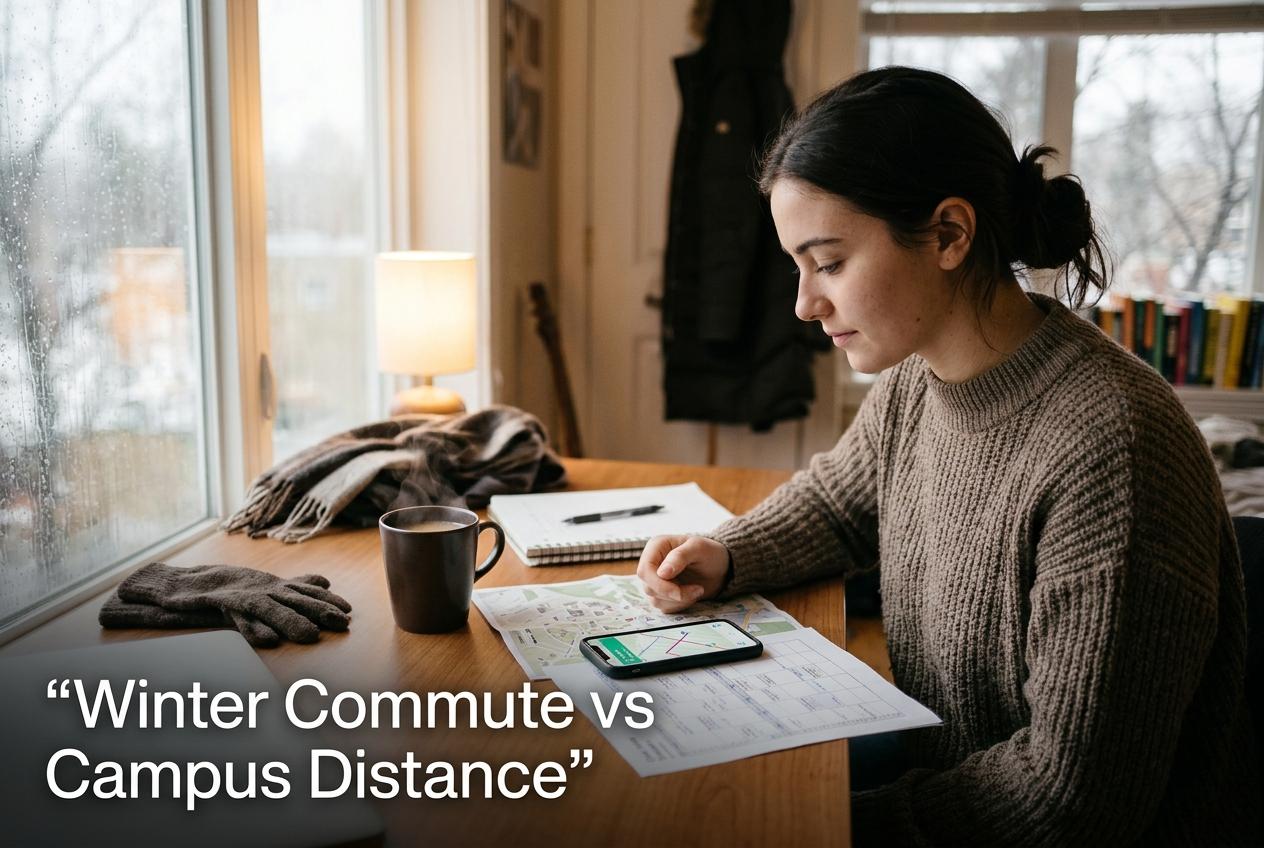
Living near campus or further away? When the weather turns colder and the days get short, living closer to university can matter more. Not because “near” is automatically best, but because winter changes the value of every journey. A shorter route can mean less time in rain, less time in the dark, and less faffing around when you’ve got an 8am or a late finish. But a good winter choice is still about the whole setup: the right teaching site, a workable route, the house itself, and what you’ll actually spend.
Here’s the short version.
| Winter decision factor | Living nearer the relevant teaching site | Living further from that site | What should decide it |
|---|---|---|---|
| Exposure to cold and rain | Less time outdoors on that journey | More time outside, or more waiting and walking for transport | Compare the full journey, not map distance alone |
| Early starts and late finishes | Often easier to manage | Can still work if the route and service times fit | Check your actual timetable |
| Daylight | A shorter journey may keep more of it usable | A longer journey may fall more outside daylight hours | Look at the time you travel |
| Gaps between classes | Going home may be practical if the route is short enough | Staying on site may be easier than making extra trips | Count likely journeys, not assumptions |
| Budget | Higher rent may be offset by lower travel spending | Lower rent may be eaten up by transport costs | Compare total housing and travel cost |
| Warmth and bills | Nearness says nothing about heating or damp | A better house may be worth a longer trip | Judge the property separately |
| Route confidence | Shorter is not always better lit or easier | A longer main-road route may suit you better than a shortcut | Check crossings, lighting and surfaces |
| Cycling | Can be handy if storage and route work | A longer distance may still be manageable | Include weather, visibility and a fallback |
The main idea is simple: distance on a map is not the same thing as a workable winter routine.
Near which University of Chester teaching site?
The first thing to get right is the destination. “Close to campus” can be misleading, because the University of Chester has more than one teaching location. That matters a lot more in winter than it does in a sunny house-hunting trip.
Exton Park, Wheeler, Queen’s Park and Creative Campus, Kingsway are all Chester teaching locations. So if a listing feels “near uni,” the real question is: near which one?
| Teaching location | Confirmed location or journey information | What it means for your choice |
|---|---|---|
| Exton Park | The University describes it as a 10-minute walk from the city centre | Useful context, but not a house-to-site estimate |
| Wheeler | On Castle Drive by the River Dee, within the city centre; the University describes it as a 20-minute walk from Exton Park | A property near one site may still mean a separate cross-city walk to another |
| Creative Campus, Kingsway | Address: Kingsway, Chester, CH2 2LB; described as a 20-minute walk from Exton Park | “Near Exton Park” and “near Kingsway” are not the same thing |
| Queen’s Park | Confirmed as a separate Chester teaching location | Use the actual building as your destination; no precise house-to-site time was established |
That last point is the one students sometimes skip. A place that works well for one building may be less convenient for another, especially if your timetable jumps around. And in winter, a timetable with gaps or evening sessions can make that difference feel much bigger.
So if you’re comparing student accommodation near the University of Chester, don’t compare against the university in general. Compare against your actual lecture, seminar or placement location.
What changes when the journey is cold, wet or after dark?
Winter makes the same journey feel longer, and sometimes it is longer in the only way that matters: time spent outside.
Chester has short December days. On 21 December 2026, sunrise is 08:23 and sunset is 15:55. Evening civil twilight ends at 16:38. That means a student setting off at 5pm is travelling after sunset and after civil twilight has ended. An 8am departure is still before sunrise.
That does not mean Chester is “pitch black at 4pm all winter.” It just means you should plan for journeys that happen outside daylight, because plenty of them will.
The local weather picture also supports the winter angle. Nearby Hawarden Airport’s long-term averages show daytime maxima around 8 to 9°C in December, January and February, overnight minima around 2°C, and regular wet and frosty conditions. So this is not really a season for casual shortcuts and optimistic shoes.
The practical test is simple:
- Would you still choose this route after dark?
- Does it feel okay carrying a laptop, bag or shopping?
- Are the crossings obvious and the pavements decent?
- Is there a better-lit alternative, even if it takes a little longer?
- If the route involves a bus, what happens at the start and end of the journey?
That last point matters because a bus journey is not just the bus ride. It is the walk to the stop, the wait, any interchange, and the walk at the other end. In winter, those bits add up fast.
A lot of students assume proximity automatically solves this. It doesn’t. A closer house can still have a poor route. A slightly further house can still work well if the route is direct, lit and easy to use.
So yes, another Chester area may suit you better than the closest-looking house. The value is in the route, not the postcode bragging rights.
Does a lower rent still save money after travel?
Sometimes yes. Sometimes no. The only honest answer is that you need to compare the whole cost, not just the weekly rent.
A useful way to think about it is:
Total housing-and-travel cost = rent over the actual charged tenancy period + excluded household bills + realistic transport spending
That means looking at:
- the actual tenancy length
- what is included in the rent
- how often you will travel
- whether you need a bus pass or individual fares
- whether you’ll be making extra trips home between classes
A short illustrative example helps make the point.
If one property is 10 minutes from your teaching site and another is 25 minutes away, that is a 15-minute difference each way. Over four days a week, with one return trip each day, that becomes two hours a week. Over a term, that is not nothing. It is time you are either spending walking, waiting or squeezing around your day.
Now look at the money side.
Stagecoach Merseyside Plus publishes a 2026–27 annual Unirider ticket at £415, with shorter-term options too. It covers travel within the Merseyside Plus Zone, including evenings, weekends and half terms. That can be useful if your route fits the network and your timetable really does involve regular bus travel.
But there are limits:
- it is a Stagecoach product, not a universal bus pass
- the route and stops must be within coverage
- a bus network existing does not mean it suits your lecture times
- student eligibility and purchase requirements still need checking
There is also the NextGenTravel scheme for eligible 16–19-year-old borough residents, with £1 single journeys on participating services. That is helpful for some students, but it is not a universal student discount, and older students are outside the age range.
The point is not that the cheapest rent always loses. It’s that the cheapest rent can stop being cheap once transport is part of the picture.
So if you are looking at student accommodation in Chester, do the unglamorous bit and add things up properly. Rent, transport, and the bits the listing does not cover.
Could another Chester area make everyday winter life easier?
Yes, possibly. But only if the location fits your actual routine, not just your sense of what sounds central.
Bed’s local housing pages name areas such as the Garden Quarter, Hoole, the Upper Canal Basin, the Lower Canal Basin and the city centre. Those are useful starting points, but they are not neat little boxes with one fixed journey time or one fixed price. Chester housing is not that tidy, sadly.
The winter question for these student areas in Chester is not “which one is best?” It is “which one works for the journeys I actually make?”
A few sensible checks:
- If you are mostly heading to one teaching site, what is the route from the exact street?
- If you need groceries regularly, is there an easy stop on the way home?
- If you split your time between home, teaching and the city centre, which location reduces repeated trips?
- If you have evening commitments, which route still feels fine after dark?
That is where area labels can help a little, but only a little. “City centre” sounds handy, but Wheeler is already in the city centre. Near the canal can sound pleasant, but pleasant in daylight is not the same thing as practical after dark. A waterside shortcut is not automatically the route you will want to use on a wet February evening.
So yes, another Chester area may suit you better than the closest-looking house. The value is in the route, not the postcode bragging rights.
Is the house itself ready for winter?
This is the bit people underestimate. A short commute cannot make up for a cold, damp or awkward house.
Winter comfort is its own decision. Before you get too focused on location, check what the property is actually like to live in.
Useful questions include:
- What heating system is installed?
- Who controls the heating schedule?
- What is included in the rent?
- Are there any usage limits or extra charges?
- How do housemates dry wet coats and laundry?
- Is there proper ventilation in kitchens and bathrooms?
- Are there signs of damp, mould or condensation?
- Who do you contact if heating fails?
Government guidance points to heating, insulation and glazing as important for energy efficiency. Energy Saving Trust also says the lowest comfortable temperature for most people is 18–21°C. That is general guidance, not a rule for every person or every house, but it does remind you that warmth is a real part of the decision.
And on damp: don’t assume it is just “student house stuff.” Damp can have several causes, and it is worth asking what has been done about it. A quick viewing won’t always tell you the whole story, so it helps to ask directly.
If you are choosing between two places, one slightly further out but warm and well managed can be a better winter choice than a closer one that feels draughty, dark or awkward to heat.
That’s the bit people forget when they focus only on walking time.
How Bed can help you compare the winter trade-offs
If you are shortlisting student accommodation in Chester, Bed’s setup is built around making that comparison a bit easier.
You can browse Chester student lets and house shares by bedroom count, availability window and price per week. You can also look for individual rooms or shared houses, which is useful if you and your housemates are not all making the same decision at once.
A few things matter here:
- bills-included options are available
- Bed says 99% of its lets have all bills included
- the Rent Calculator gives monthly and yearly estimates
- the letting process is set out step by step
- viewings can be arranged, including virtual viewings
That does not mean every property is identical, of course. You still need to check the actual listing and agreement. But it does mean you can compare a property’s location with its practical cost more clearly.
A decent winter shortlist usually comes down to this:
- Does the route work for your teaching site?
- Does it still work after dark?
- Is the house itself warm and manageable?
- Do the rent and transport costs still make sense together?
If the answer is yes on all four, that place is probably doing its job.
The bottom line
Being nearer campus can matter more in winter because it reduces time outdoors and makes early starts, late finishes and in-between trips easier to handle. But it is not a blanket winner.
The better choice is the one that works as a full winter routine: the right teaching site, a route you would actually use in the dark, a house that feels warm enough to live in properly, and a total cost that still makes sense once transport is included.
That is the real test for student accommodation near the University of Chester, and it is a better one than “how close does it look on a map?”
If you are still weighing up options, shortlist the houses or rooms that fit your weekly budget, then compare the route to your actual teaching site and check what is included in each rent. Bed can help you arrange viewings so you can judge location and winter practicality together.
FAQ
Does being nearer campus matter more in winter?
It often does, because a shorter route means less time in cold, wet or dark conditions. That said, it is only one part of the decision. Route quality, heating and total cost still matter.
Is it cheaper to live further from the University of Chester?
Not necessarily. No reliable like-for-like rent difference between Chester areas was established here, so you need to compare the actual listing, the tenancy length and your transport costs.
Can I rely on buses instead of living close to my teaching site?
Sometimes, if the route, timetable and ticket fit your routine. But a bus being available in theory is not the same as it working for an early lecture or a late return.
What should I check at a winter viewing?
Check the route after dark, the heating controls, ventilation, signs of damp, what bills are included, and who to contact if there is a heating problem. That gives you a much better picture than a quick daytime look.
Written By

Jolan_Tucker_BSR